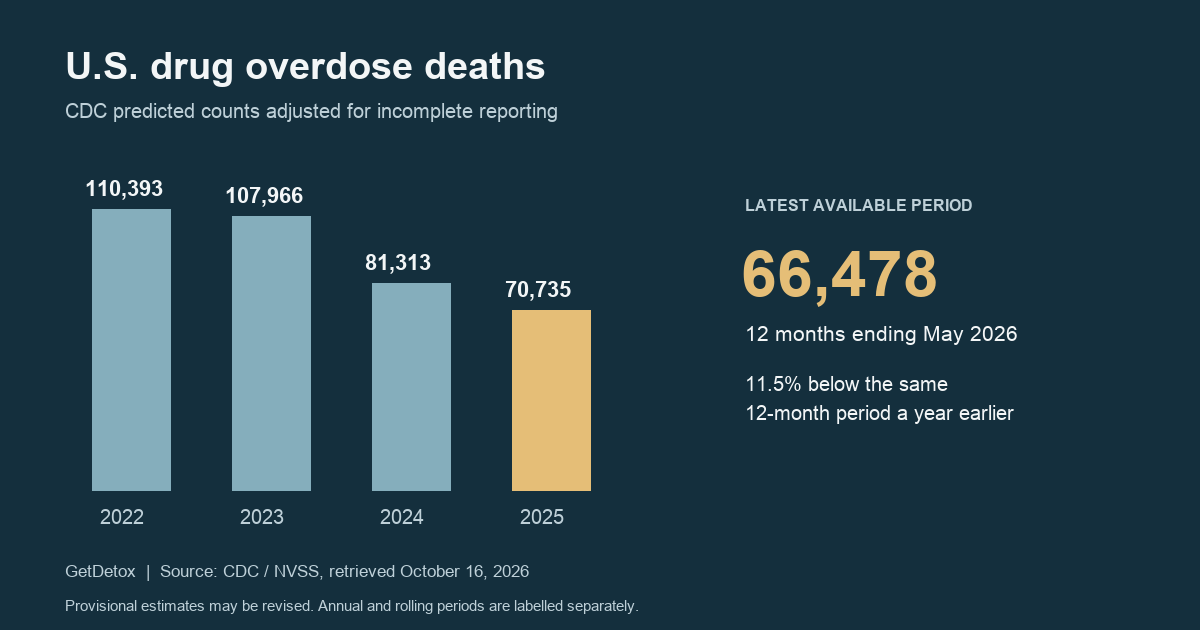
Data checked October 16, 2026: These are CDC predicted counts adjusted for incomplete reporting, rather than final death-certificate totals. The latest available period in the source dataset ends in May 2026. Figures can change in later releases; the underlying CDC provisional overdose dashboard is updated monthly.
Quick answer: U.S. drug overdose deaths fell to about 70,735 in 2025, a decline of about 13 percent and the third consecutive annual drop, according to CDC provisional data. The most recent 12 month data, ending May 2026, predicts 66,478 deaths, down 11.5 percent. Fentanyl remains the main driver of opioid overdose deaths, and 80 percent of people who need substance use treatment still do not receive it.
This page is a regularly updated collection of verified U.S. drug overdose and opioid statistics. Every number below comes directly from a primary federal source: the Centers for Disease Control and Prevention (CDC), the Substance Abuse and Mental Health Services Administration (SAMHSA), the National Institute on Drug Abuse (NIDA), or the Drug Enforcement Administration (DEA). Each statistic is presented as a standalone fact with its source, so researchers, journalists, and students can cite it with confidence.
Key Drug Overdose Statistics at a Glance
- 70,735 predicted U.S. drug overdose deaths in 2025, down about 13 percent from 2024 (CDC provisional dataset, retrieved October 16, 2026).
- 66,478 predicted overdose deaths for the 12 months ending May 2026, a 11.5 percent decline year over year (CDC NVSS dataset, retrieved October 16, 2026).
- 3 consecutive years of declining overdose deaths after the national peak in 2022.
- 45,065 estimated opioid-involved overdose deaths in 2025, down from 55,296 in 2024 (CDC provisional data).
- Leading cause of death for Americans aged 18 to 44: drug overdose (CDC).
- 4.8 million Americans aged 12 or older had opioid use disorder in 2024 (SAMHSA NSDUH).
- 7.6 million people misused prescription opioids in 2024, down from 8.9 million in 2023 (SAMHSA NSDUH).
- 48.4 million Americans, or 16.8 percent of people 12 and older, met criteria for a substance use disorder in 2024 (SAMHSA NSDUH).
- 80 percent of people who needed substance use treatment in 2024 did not receive it (SAMHSA).
- 107,966 overdose deaths occurred in 2023, about 296 per day, before the recent decline accelerated (CDC).
U.S. Overdose Deaths in 2025 and 2026: The Numbers
The CDC dataset retrieved on October 16, 2026 estimates 70,735 drug overdose deaths in the United States during 2025. That represents a decline of about 13 percent from the 81,313 deaths estimated in 2024.
The newest available CDC data extends into 2026 and reflects records available for analysis on October 4, 2026. For the 12 month period ending May 2026, CDC predicts 66,478 overdose deaths, a 11.5 percent decline compared with the 12 months ending May 2025. Deaths have now fallen for three consecutive years after peaking in 2022.
The improvement is not uniform. In the 2025 data, Rhode Island, New York, North Carolina, Alabama, and Vermont saw declines of 25 percent or more. New Mexico, Arizona, and Colorado saw increases of 10 percent or more compared with the same period in 2024.
Overdose deaths by year
| Year | U.S. overdose deaths (approx.) | Trend |
|---|---|---|
| 2022 | Peak of the epidemic, about 110,393 | All time high |
| 2023 | About 107,966 | First decline |
| 2024 | About 81,313 estimated | Steep decline |
| 2025 | About 70,735 estimated | Third straight decline |
| 12 months ending May 2026 | 66,478 predicted | Down 11.5 percent year over year |
Sources: CDC National Vital Statistics System provisional data. Provisional counts are adjusted estimates and may change as records are finalized.
Fentanyl and Opioid Overdose Statistics
Illicit fentanyl remains the single deadliest drug threat in the United States. CDC provisional data showed overdose deaths involving opioids decreased from an estimated 55,296 in 2024 to 45,065 in 2025, but opioids still account for a large share of fatal overdoses.
Encouragingly, deaths involving opioids, cocaine, and psychostimulants all declined in the 2025 data, suggesting a broad shift rather than a single substance trend. For a clinical breakdown of fentanyl potency, half life, and withdrawal, see our network resource at opiates.org and the complete opioid drug guide library.
The Addiction Treatment Gap
The most important statistic on this page may be the one that has barely moved: 80 percent of Americans who needed treatment for a substance use disorder in 2024 did not receive it, according to SAMHSA. Out of 48.4 million people who met diagnostic criteria for a substance use disorder, only 10.2 million received any form of substance use treatment that year.
For opioids specifically, SAMHSA's 2024 National Survey on Drug Use and Health found 4.8 million Americans with opioid use disorder and 7.6 million who misused prescription opioids in the past year. The treatment gap means millions of people who are physically dependent on opioids never receive medical care for withdrawal, which is one reason so many attempt to stop on their own and relapse.
Why Are Overdose Deaths Falling?
Researchers cannot yet point to one definitive cause, but several factors are consistently cited:
Naloxone access. The FDA approved over the counter naloxone in 2023, and pharmacy dispensed naloxone has expanded sharply since. Treatment expansion and settlement funding. Billions of dollars in opioid litigation settlements are now reaching state and local programs. Drug supply changes. DEA reporting and independent researchers have pointed to changes in the illicit fentanyl supply. A smaller at risk population. Fewer teenagers are initiating drug use, and tragically, many long term users have already died.
Despite the progress, overdose remains the leading cause of death for Americans aged 18 to 44, and monthly deaths are still well above levels seen before the opioid epidemic began.
What These Numbers Mean for Someone Who Needs Help
Behind the treatment gap statistic is a practical reality: opioid dependence is a medical condition, and withdrawal is a medical event. People who receive proper medical care through withdrawal are far better positioned to reach and sustain recovery than those who attempt to quit alone.
Evidence-based treatment for opioid use disorder includes buprenorphine, methadone, and naltrexone, with the level of medical and behavioral support matched to the patient. Buprenorphine and methadone reduce overdose and overall mortality. Detoxification alone is not recommended treatment because lowered tolerance increases overdose risk if opioid use resumes. CDC and ASAM advise against anesthesia-assisted ultrarapid detoxification because of serious safety risks. Learn more in our rapid detox evidence guide, compare opioid withdrawal timelines, or locate care through FindTreatment.gov.
Frequently Asked Questions
How many people died from drug overdoses in 2025?
CDC provisional data predicts about 70,735 U.S. drug overdose deaths for 2025, down about 13 percent from 81,313 in 2024. It is the third consecutive annual decline.
Are overdose deaths going up or down in 2026?
Down. The most recent available CDC data, covering the 12 months ending May 2026, predicts 66,478 overdose deaths, a 11.5 percent decline compared with the prior year.
What drug causes the most overdose deaths?
Illicit fentanyl remains the main driver of opioid overdose deaths. Opioid-involved deaths declined in 2025, but opioids still account for a large share of fatal overdoses.
How many Americans have opioid use disorder?
About 4.8 million Americans aged 12 or older had opioid use disorder in 2024, and about 7.6 million misused prescription opioids, according to SAMHSA's National Survey on Drug Use and Health.
What percentage of people who need addiction treatment actually receive it?
Only about 1 in 5. SAMHSA reports that 80 percent of people who needed substance use treatment in 2024 did not get it.
Why are overdose deaths declining?
Likely a combination of factors: over the counter naloxone, expanded treatment access, opioid settlement funding, and changes in the illicit fentanyl supply. No single cause has been confirmed by researchers.
How to Cite This Page
GetDetox Editorial Team. "Drug Overdose Statistics 2026: Latest CDC and SAMHSA Data." GetDetox.com. Reviewed for addiction counseling and recovery context by Clare Waismann, M-RAS, SUDCC II. Data updated October 16, 2026. https://getdetox.com/drug-overdose-statistics/
Primary Sources
- CDC Overdose Prevention, Facts and Statistics: cdc.gov/overdose-prevention
- CDC NCHS, Provisional Drug Overdose Death Counts: cdc.gov/nchs/nvss/vsrr
- CDC NCHS Press Release, May 13, 2026: cdc.gov/nchs/pressroom
- SAMHSA, 2024 National Survey on Drug Use and Health: samhsa.gov/data
- National Institute on Drug Abuse (NIDA): nida.nih.gov
- National Institute on Drug Abuse (NIDA), Fentanyl: nida.nih.gov
This page is provided for educational purposes and is not a substitute for professional medical advice. Statistics are provisional where noted and are updated as federal agencies release new data. If you or a loved one is struggling with opioid dependence, speak with a qualified physician.